All the images—illuminated manuscripts, city plans, and engravings—along with the accounts of travelers, attest to the strong presence of vineyards within the city walls or at the foot of the ramparts from the 11th to the 19th century. For various religious, honorary, and culinary purposes, the vine was ubiquitous in all cities from the early Middle Ages. Whether within the walls or outside, it was a matter of security and available space.
Lyon
The grand scenic plan of Lyon in 1545 depicts vineyards and winemakers at work within the fortified walls. Vineyards can be found throughout the eastern slope of the Fourvière hill, from Saint-Irénée to Pierre Scize. In the peninsula area, they share the vast unfortified space, which stretches from the present-day Place Bellecour to the sandy islets at the confluence, with gardens and meadows lined with willows. All these vineyards belong to the archbishop and the canonical chapters. The winemakers are housed on-site in wretched huts made of wattle and daub or rammed earth, built at the corners of the plots. Other peasant vineyards exist on the plateau and the southern slopes of Croix-Rousse.
In 1493, a census recorded 200 Lyonnais winemakers living in the city and cultivating 230 hectares of vineyards. Starting in 1470, with the region secured by King Louis XI and his daughter, the regent Anne de Beaujeu, the vineyard belt began to loosen. New vineyards were established in the 16th century on the Lyonnais plateau and in the lower Beaujolais.
Toulouse
Here too, the vine is found within the city. The first fortified wall was demolished after 1230 to punish the city for supporting the Albigensian revolt. The new wall greatly expanded the protected area, and vast spaces to the south and north remained undeveloped, covered with gardens and vineyards. The great fires of 1408, 1442, and especially 1463 demonstrated the effective firebreak role played by the rows of vines. The Tavernier plan of 1632 associates orchards with vineyards. Similar to Lyon, these are ecclesiastical and bourgeois vineyards, and the wine produced is sold in the city without paying taxes.
Dijon
In Dijon, the winemakers enjoyed the same privilege until the 17th century. One inhabitant in twelve was classified as a winemaker in the numerous tax censuses around 1400. They primarily lived in the outlying parishes of Saint-Nicolas in the northeast, Saint-Michel, and Saint-Philibert in the west (the vineyards of the Saint-Bénigne monastery). Their small houses were surrounded by gardens and vineyards, featuring a buried cellar or storage area below and a small tool shed.
In February 1630, they grew concerned about a challenge to their tax privilege, as King Louis XIII sought to subject Dijon wine to the ferme des Aides (a royal tax of 30 to 40%). On February 28, more than five hundred winemakers, armed with their sharpened pitchforks, spread throughout the city, pillaging and setting fire to several houses, including that of the general treasurer. Led by the young King Louis XIII himself and his Keeper of the Seals, Michel de Marillac, the crackdown was harsh, with public executions and many expulsions of winemakers.
Bordeaux
No major city in France—and perhaps in the world—has such ancient and close ties with a large suburban vineyard as Bordeaux. Its origins are political, fiscal, and commercial. From the early 13th century, the English kings, dukes of Aquitaine, granted numerous privileges to the inhabitants or « bourgeois » (those residing in the town) of Bordeaux: they were exempt from taxes, including the « petite coutume » on wines sold in the city and the « grande coutume » on wines shipped by sea from the port. They enjoyed the privilege of Bordeaux: other wines from Aquitaine were blocked on the banks of the Garonne until all Bordeaux wines were shipped on the great fleet in October.
Well protected by the Bordeaux Jurade, bourgeois wine was produced massively within a radius of about 8 km, on the left bank in the gravel soils of Caudéran, Pessac, Talence, and Bègles, and on the right bank in the lowlands of Queyriès. It is in Lormont that the Archbishop of Bordeaux has his vineyards. The winemakers, whether small landowners, sharecroppers, or wage laborers (laboradores de vinhas), crowded into the city, particularly in the parishes of Saint-Seurin, Saint-Genès, and Saint-Michel. During the harvest, carts transported the grapes into the city, where the presses—available for a fee—were located, and the wine was immediately sold and removed; this was the light wine from short fermentations that would become the much-appreciated French claret among the English.
The long Hundred Years’ War and the reconquest of Aquitaine by the French did not change this situation: King Charles VII had to confirm the tax exemptions and commercial privileges. As European demand continued to grow, new vineyard areas were cleared from forests or marshlands in Médoc, Graves, and the right bank of the Garonne. The large aristocratic and bourgeois estates moved further from Bordeaux, and the vineyard belt began to loosen and expand. The urban suburbs also extended, and by the late 19th century, a battle had begun between the vine and the stone, brick, and concrete.
Today, a few bastions of viticulture remain, supported by some prestigious estates: Château Pape-Clément and Château Haut-Brion. At Mérignac, Château Pique Caillou still exists, nestled among its twenty hectares of vineyards, though it has been « scarred » by a fast road. The establishment of the Pessac-Léognan appellation in 1987 has significantly contributed to the preservation of the vineyard landscape in these suburban municipalities.
There is no harvest festival in Bordeaux, but there is a beautiful wine festival along the revitalized quays. Numerous heads of Bacchus and cherubic harvesters, along with grape leaves, adorn the buildings. Additionally, the Cité du Vin, which opened its doors in May 2016, aims to explain the present and prepare for the future, located right where the barrels of wine from the Haut Pays were stacked in the Middle Ages.

Paris
For nearly two millennia, the vine and wine remained at the heart of Paris’s history. Reintroduced by the Gallo-Romans in the mid-2nd century, the foremost vineyard was held by the great abbey of Saint-Germain, near the Île de la Cité. The Benedictine monks planted vines all over the Montagne Sainte-Geneviève and received parcels from kings and great feudal lords across Île-de-France. Around the year 820, a general inventory reported 400 hectares of vineyards. Half were cultivated by the monks themselves, their serfs, and agricultural workers, while the other half was distributed as sharecropping to tenant winemakers. By the end of October, the abbots became wine merchants, selling at the grand fair of Saint-Denis founded by King Dagobert. The wines for sale were exempt from any tax, and Charlemagne would renew this privilege.
From the 12th to the 18th century, the vineyards of Île-de-France produced the renowned wine of France, carefully distinguished from the wines of Champagne, Orléans, or Burgundy. References were always made to the Capetian and Valois kings, serving as a mark of origin verified by brokers who attested to the nobility, loyalty, and quality of French wines. The first royal vineyards were planted in the 10th century on the Île de la Cité. Arbors bordered the inner gardens of the Louvre Palace. Maps of Paris from the 16th century show a wide dispersion of vineyards on both sides of the river. Due to a lack of space, they no longer existed within the old walls of Philippe-Auguste. Some religious vineyards remained at the foot of the walls of Charles V (1360), such as those of the Temple and the Célestins on the right bank, and those of the Bernardins and Saint-Germain on the left bank. Many arbors surrounded gardens and courtyards. Those lining the streets, highly visible on the 1560 map, disappeared when Henry IV began paving the muddy thoroughfares of the capital. Large parcels encircled the city in the heights of Passy and Montreuil to the north, and in Vanves, Montrouge, and Issy to the south. This set the stage for a great vineyard belt, initially hindered by a 1577 Parliamentary decree aimed at promoting a cereal belt to prevent famine. It prohibited Parisian merchants from buying wine within a radius of twenty leagues (about 100 km) around the capital. However, nothing prevented Parisians from bringing in wine from their own vineyards for personal consumption and reselling it at home. This measure, however, favored producers from Orléans and Blois.
Île-de-France viticulture truly expanded in the 18th century after the great frost of 1709, which sparked a widespread planting frenzy. By 1852, there were 45,000 hectares of vineyards in Seine, Seine-et-Marne, and Seine-et-Oise! But by the early 20th century, the railroad, phylloxera, competition from southern wines, declining quality, and rampant urbanization would put an end to it all.
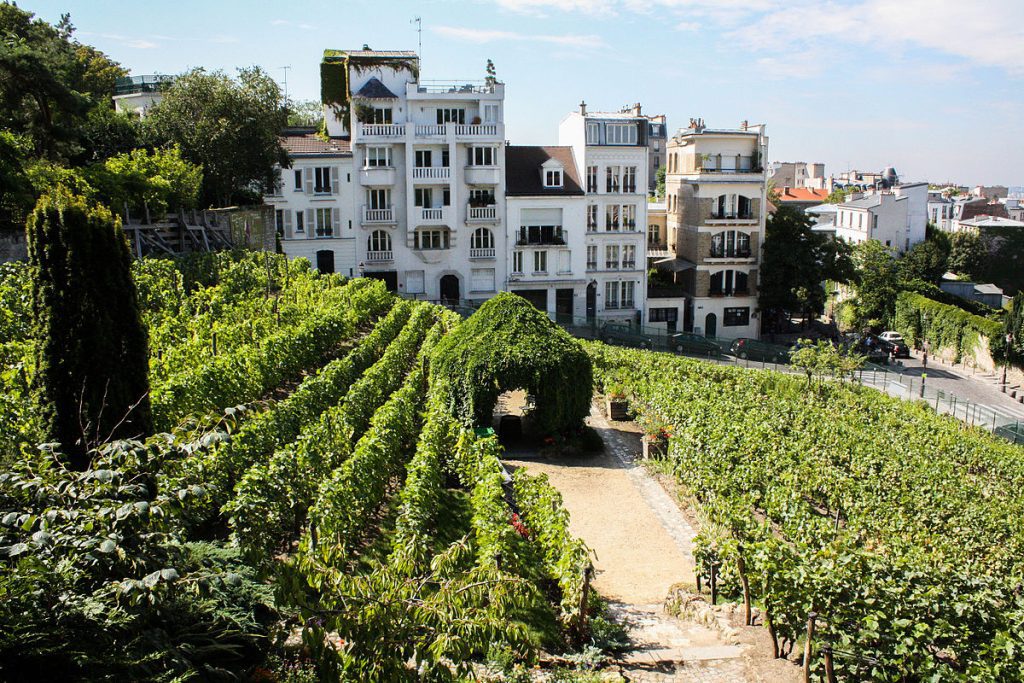
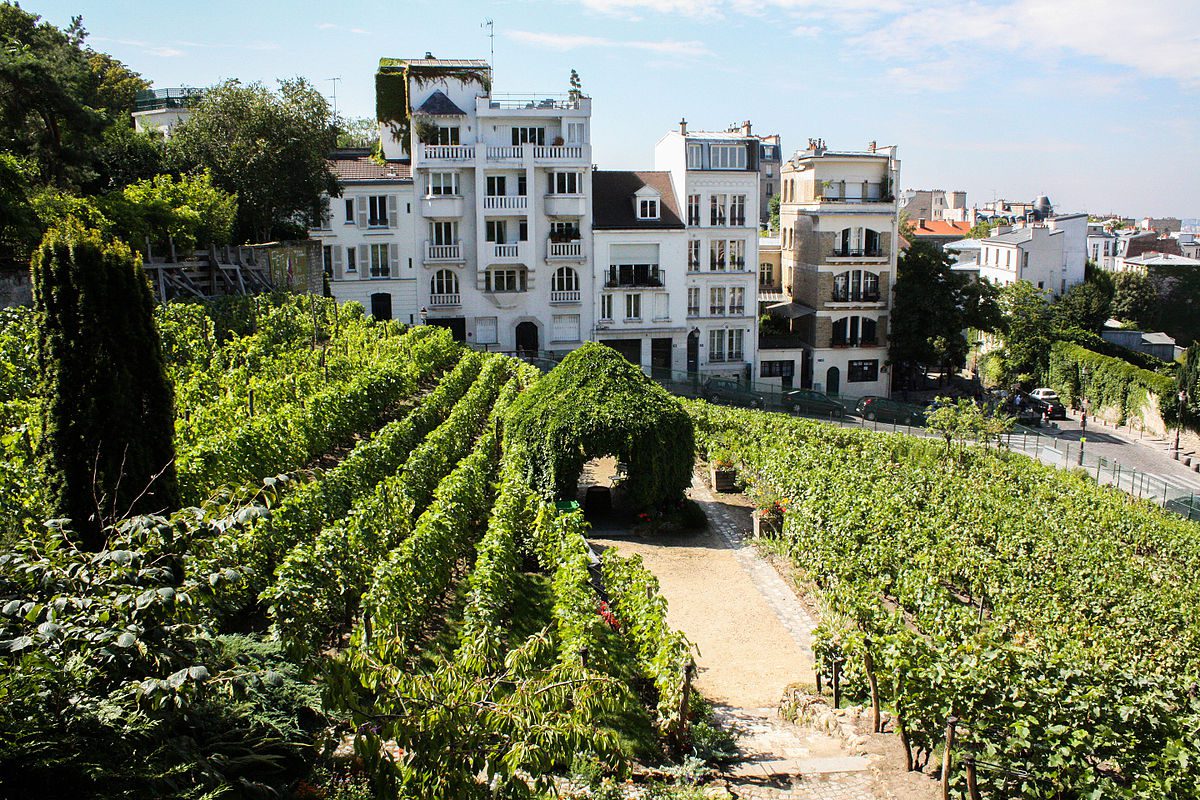
Today, there remain about ten vineyards within the city limits of Paris: Montmartre, the historic one, with 1,762 vines; Parc de Belleville, the festive one, with 140 vines; Parc de Bercy, the authentic one, with 400 vines; Bagatelle, the private one, also with 400 vines; as well as Georges Brassens, with 720 vines, and Butte-Bergeyre, the small one, with 60 vines.
Montpellier
In Montpellier, the vine forms a crown around the city, from Saint-Jean de Védas to Saint-Georges d’Orques, Fontfroide, and Castelnau. It is owned by the aristocracy and a wealthy bourgeoisie who produce wine in the cellars of their townhouses. Thus, in September, donkeys and mules can be seen transporting baskets of grapes into the city, while a « sweet smell of wine » spreads throughout. Starting in the 16th century, this aristocracy began to build their new residences in the countryside; laborers and independent vintners settled in the larger villages of the plain.
Orléans
The same is true in Orléans, where ecclesiastical viticulture first developed within the walls of the early convents. The city was cut off from its suburbs and vineyards by the construction of a solid fortified wall in the early 15th century, but it retained its laborers who worked in the vineyards for others and who go every morning to work (around 200 for the Hôtel-Dieu alone). Their day begins at five o’clock and doesn’t end until nightfall, announced by the bell of the cathedral. Then a shout rises from the vineyards to signal that it’s time to leave work. And if the guards take too long to open the gates, the vineyard workers noisily clash their heavy hoes together, making a great racket.
And elsewhere …
A similar scene unfolds in Auxerre, Metz, Saumur, Tours, Reims, Avignon, Perpignan… Marseille is not on the list because, from the very beginning, the Phocean city preferred to import its wine from elsewhere, primarily by road and especially by sea, from all the wine-producing coasts of the Mediterranean.
– Brigitte Savigneux according to an article from Gilbert Garrier