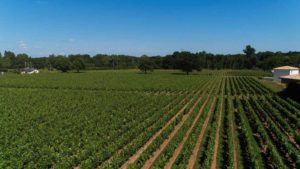
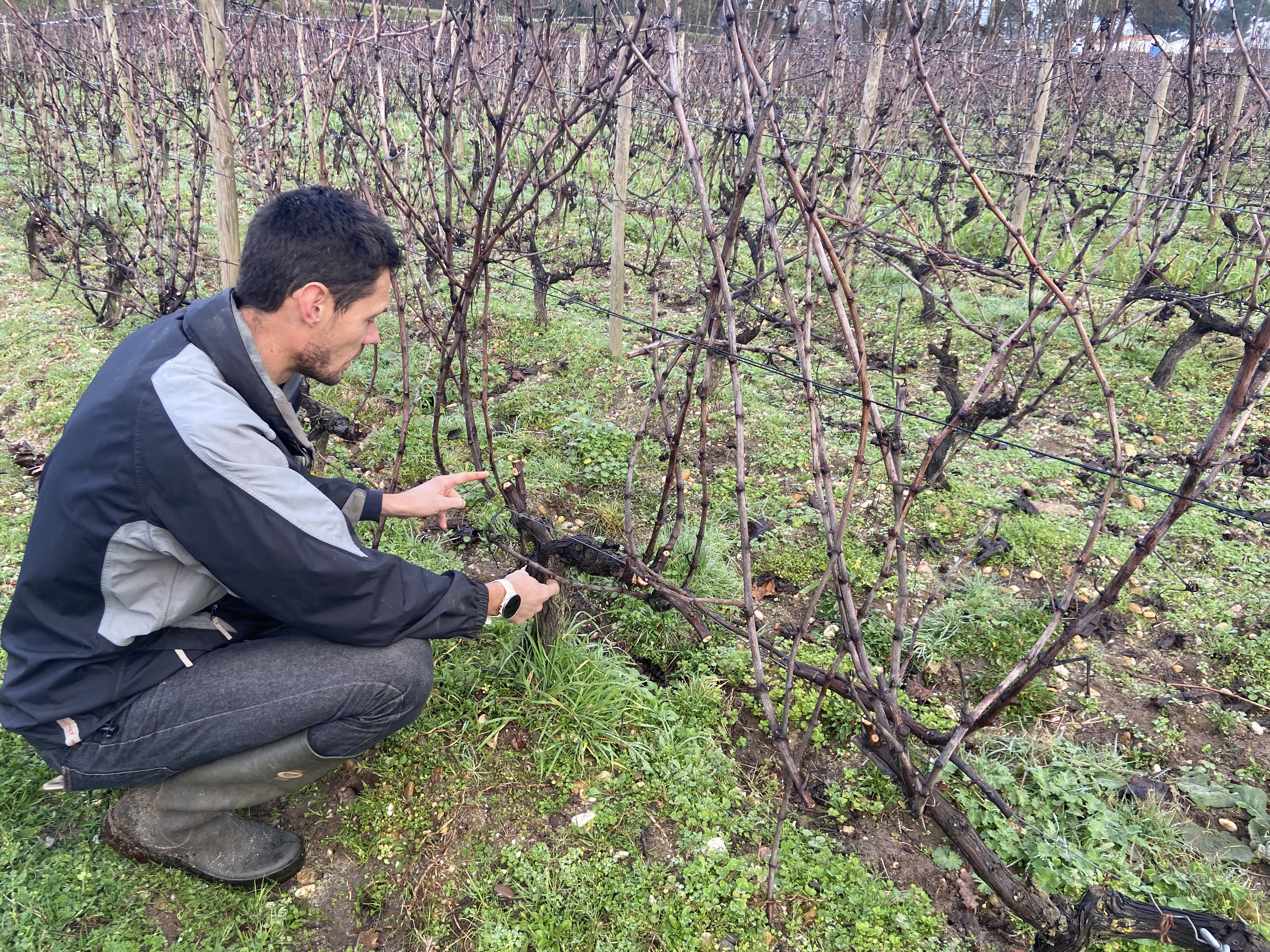
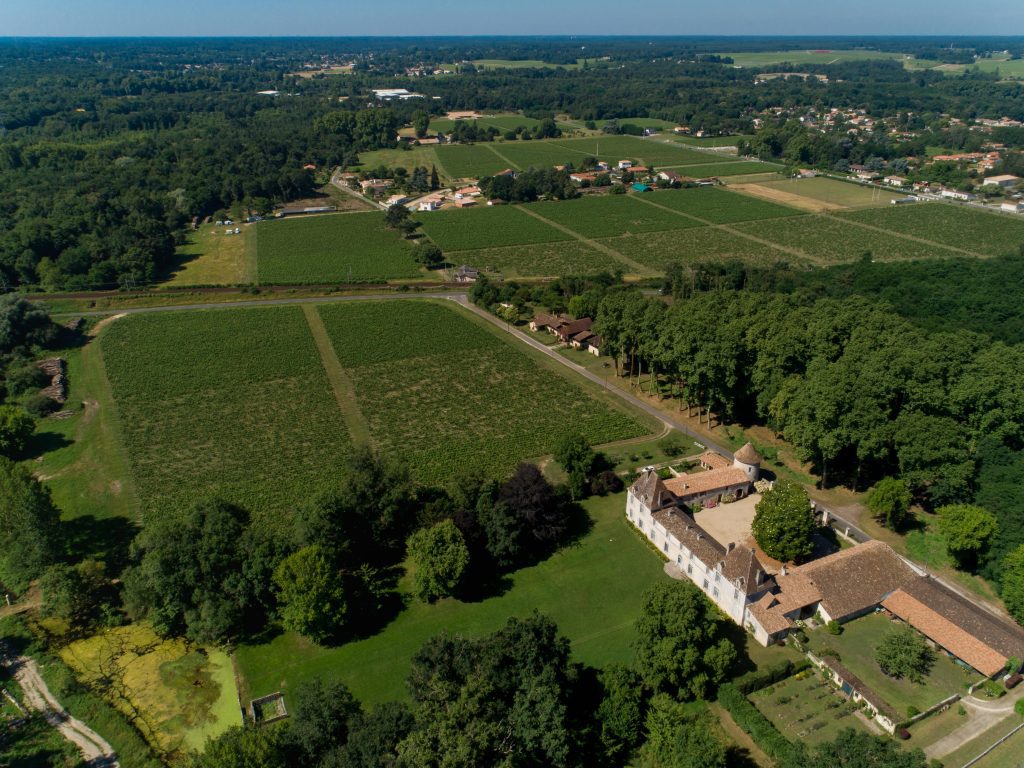
While walking through the vineyard this week, I had the chance to run into Florian, the vineyard manager at Château d’Eyran, busy pruning the vines with his team. This meeting turned out to be a great opportunity to chat with him and ask the questions that had been on my mind.
For those of you who find vine pruning a nebulous concept, I invite you to check out an article we published last year. However, if you’re curious about Florian’s thoughts on this particular period, I encourage you to continue reading here!
Hello Florian, can you explain what pruning means to you?
In my view, pruning represents the beginning of the vine’s vegetative cycle. It’s not the end of one year, but rather the start of a new one; this is where everything takes off.
You see, the vine follows a regular, cyclical vegetative cycle, with tasks that repeat year after year. Pruning truly marks the start of the season, and the choices made at this time determine the harvest for the upcoming year, and sometimes even for the two years that follow, depending on the retained and used wood.
I believe that after planting, pruning is the essential link that shapes the harvest. What’s particularly interesting at this stage is the decision-making aspect; the choices made not only have physiological implications but also impact future yields.
So it’s a time full of decisions; do you think it’s a stressful period?
I wouldn’t describe pruning as particularly stressful because the timeframe is relatively extended. This year, we chose to start in January (with an estimated end in late February), but aside from the risk of frost, it would be possible to begin as soon as the leaves fall in November/December.
In my opinion, once the team is well-trained and has grasped the subtleties of pruning, there’s no reason to feel stressed. Of course, a rhythm must be maintained, but we have the necessary time to complete the task and make adjustments if needed. Unlike other stages, such as treatments, which have strict deadlines and high risks if not completed in a day, here the luxury of time helps reduce stress and allows for anticipation.
The real stress factor comes later, with the winter climate uncertainty that can influence the progression of spring.
So, what is this pruning rhythm? How do you calculate it?
To get an idea and organize ourselves, we refer to the average work from previous years. However, we can also rely on the collective agreement, which provides guidelines on the duration of work based on the type of pruning chosen. In both cases, the rate is calculated in hours per 1,000 vines, forming our counting base.
I believe that a pruner’s effectiveness comes from a quick and accurate assessment of the vine, as well as great skill in handling the secateurs, developed over time through experience.
On average, a skilled pruner spends about 9 to 9.5 hours per 1,000 vines. That’s the level of performance we expect from our team today. However, this estimate depends on the work done the previous year, particularly regarding trimming. Naturally, the more wood there is to prune, the more time it takes per vine. Additionally, some plots may have gaps in vine density, which also affects productivity.
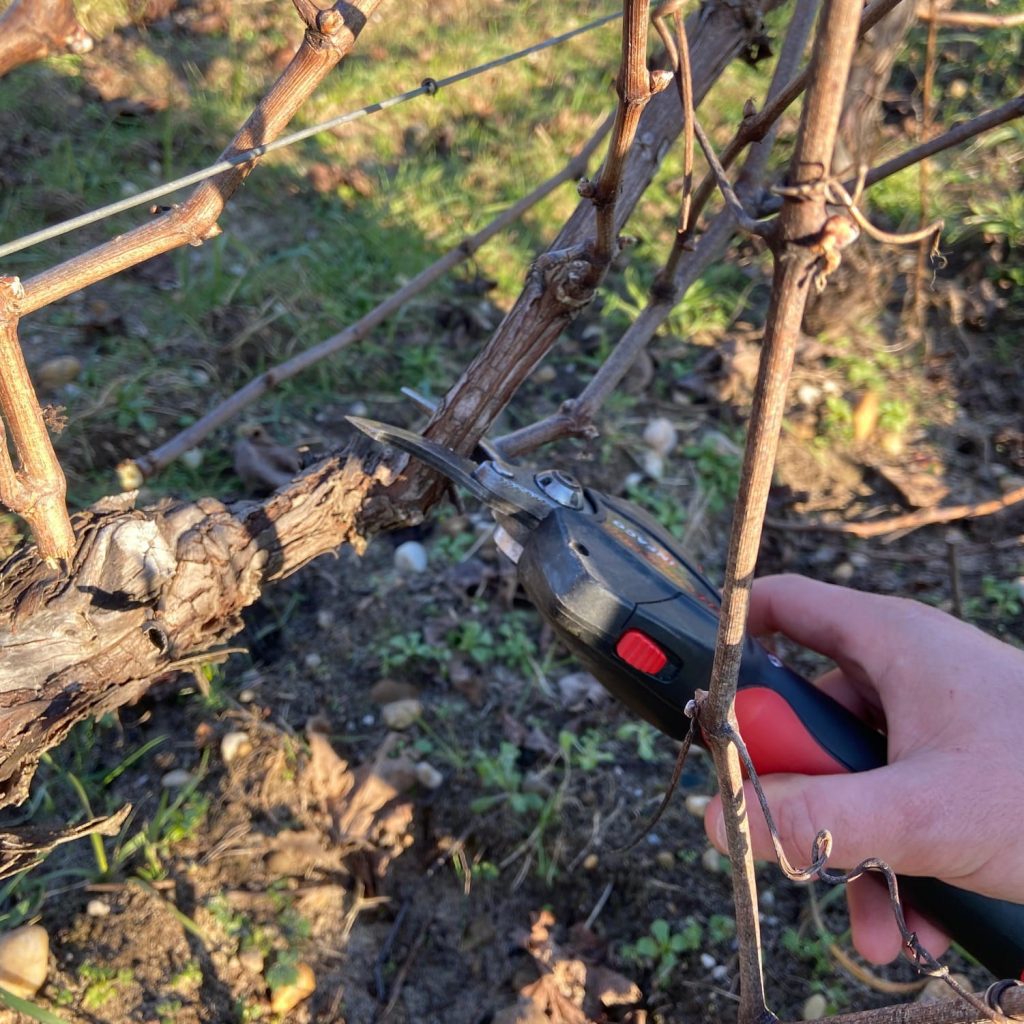
As for the yield per hour, based on my personal experience, I typically prune about 120 vines per hour.
Do you enjoy pruning?
Yes, I really enjoy pruning, especially in plots where the vines are vigorous, with good wood, healthy plants, and wise wood choices. However, when the vigor is lower, and the choices are more about necessity than preference, the experience is a bit less enjoyable.
It’s true that with well-developed, vigorous vines, the process is clear. Paradoxically, in those cases, pruning can take a bit longer due to the need for many small cuts. On the other hand, with less vigorous vines, where we make larger cuts, the process can be quick, but it doesn’t align with what we’re looking for, making it less stimulating.
I think this is really inherent to the nature of the vine itself. It doesn’t necessarily come from previous wood choices or vigor issues, but sometimes simply due to unfavorable weather conditions, our options are limited. Even if these choices become obvious given the circumstances, they don’t always match the initial plan.
But what I find fascinating about pruning, as mentioned earlier, is that it marks the starting point of the year. Starting with a bushy vine with wood in every direction and ending up with almost nothing—knowing that the entire harvest will stem from this—is truly satisfying.
What are the main elements to consider when pruning vines?
First of all, it’s essential to identify fruitful wood, as this is the cornerstone of a pruner’s work. With our new pruning approach, it’s crucial not only to apply the guidelines but also to adapt them based on the specifics of each vine.
As we discussed earlier, when conditions are ideal and all the wood is uniform, applying the guidelines is simple and quick. However, as soon as different situations arise, it’s necessary to readjust or interpret the guidelines based on the unique characteristics of each vine.
What would be an ideal day for pruning, in your opinion?
Of course, let’s be honest—working outdoors in bright sunshine is more pleasant. However, if we really consider what an ideal day for pruning would look like during this time, it would involve a very cold morning, even down to -5 degrees, with a clear sky. When it’s frozen and the sky is clear, sure, it’s cold for the first hour (especially for the fingers), but then the warm sun takes over, making the experience much more enjoyable!
In January, we had a day when we could prune in t-shirts, which felt great at the moment. But normally, such conditions are more common at the end of February or early March, when spring gradually sets in, not as early as January or early February. While it’s nice, it can be a bad sign, as all the cold we miss now might manifest later when the vines are more advanced and therefore more vulnerable. We always think about the implications, not just in terms of frost protection (for which we are prepared) but also regarding potential harvest issues that could arise later on.
With these changes in seasons and climates, how has pruning evolved here in recent years?
A concerning observation is emerging in vineyards as well as in many other sectors: the general decline of plants. The crucial question is its origin. Is it an intrinsic problem with the vine roots themselves? In-depth studies conducted by researchers have revealed that the cause lies in the sap flow, which is not optimal according to traditional practices, particularly regarding wood selection and the pruning wounds inflicted based on those choices.
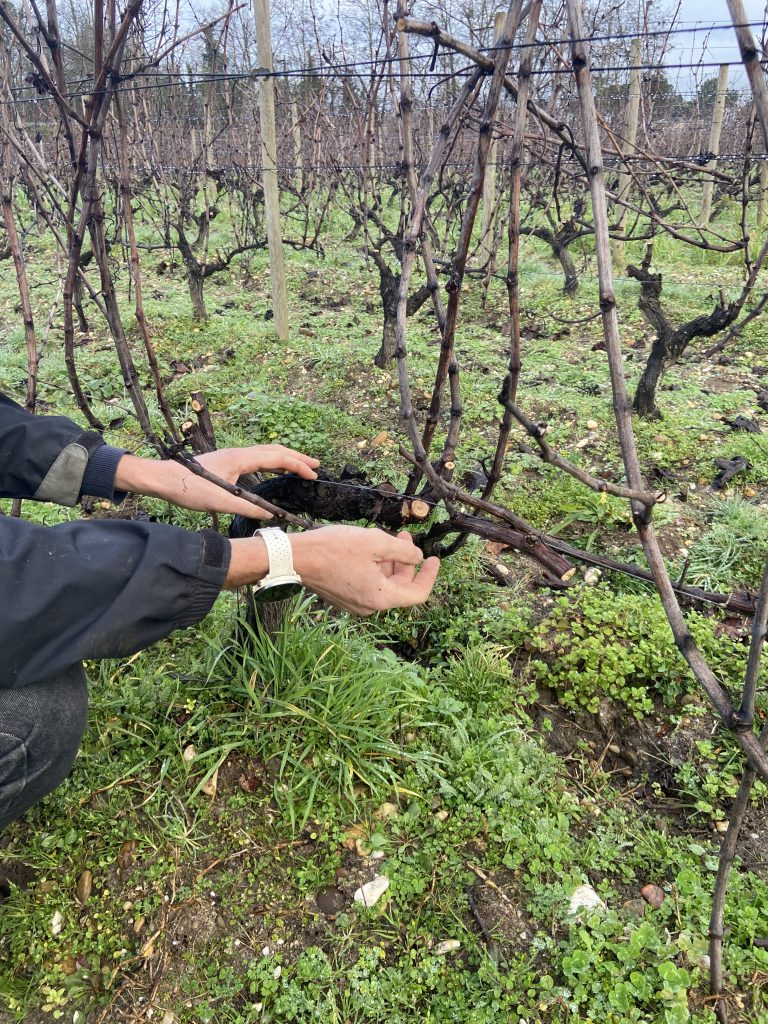
It’s important to note that the sap flows along the periphery of the plant, circulating outward. Therefore, the method we’ve adopted since last year involves allowing the vine to grow while maintaining strict control over its growth to prevent any overflow. To achieve this, we only prune on wood that is one to two years old. We’ve observed that healing of pruning wounds on older wood can not only become necrotic at the cut point but can also extend down to the graft point, disrupting the optimal sap flow from the base of the plant.e.
By pruning on younger wood, we find that healing is limited to the insertion point, thereby preserving the proper functioning of the vine’s vascular system. This has led us to modify our practices regarding both the choice of wood and the types of cuts made. Previously, we would cut excess wood flush (the shoots), leaving a completely bare surface that prevented any regrowth. Now, we leave a few millimeters of wood around the cut, preserving latent buds that may eventually develop. This approach encourages localized healing and avoids issues related to sap flow toward the retained wood.
Pruning is indeed a complex technical choice. Do you think it’s necessary to frequently rethink pruning practices in a vineyard?
I believe that constantly questioning everything can be complex and sometimes unnecessary, as the effects of a new pruning method do not show up in just one season but rather over several years. Moreover, with climate disruptions like frost, it becomes difficult to assess their real impact.
On the other hand, regular observation of the vineyard at all vegetative stages allows us to see how the vine behaves over the years, enabling us to adjust our practices. That’s exactly what we’ve done recently by relying on past observations. We’ve asked questions, sought answers, and consulted specialists who have studied vine principles. While each professional may have different viewpoints, we have chosen a clear direction and are sticking to it, while remaining open to adjustments over time.
This season marks the first full implementation of our new method, and indeed, the way we prune today differs significantly from my practices five years ago. So yes, I think it’s essential to adopt a thoughtful approach, to question ourselves when necessary, but not to be extreme and change every year.
As we said, every vineyard is different. Has this led to differences in pruning between Château Bastian and Château d’Eyran?
The same pruning technique is applied in both estates, with only differences in workforce and scheduling.
At Château Bastian (Bordeaux appellation, located in Auros), we have one person dedicated to pruning, while at Eyran (Pessac-Léognan appellation, in the village of Saint-Médard-d’Eyrans), our team consists of five people (sometimes six with me). Each season starts with a common day where we assess and adjust the pruning as needed.
At Bastian, we have an average of 30,000 vines to prune, knowing that one person prunes about 10,000 vines per month. Thus, it requires three months of work, which is why we start as early as December. At Eyran, as mentioned earlier, we began in January this year. The terroirs present differences, with Bastian being less sensitive to frost due to its more hilly location compared to Eyran.
At Eyran, the team starts the pruning season with five people. Towards the end of the pruning, we anticipate the necessary tasks in the vineyard. Depending on the remaining volume, we generally assign three people to pruning while the other two prepare for the post-pruning tasks. This way, once the last vines are pruned, we can quickly move on to the bending stage.
Thank you Florian !
As you’ve surely understood, the topic of pruning is both vast and fascinating. I sincerely hope you enjoyed this article format and found it engaging. If you have any additional questions or points to discuss, please don’t hesitate to reach out to us. We’re here to share our passion for the craft!
See you soon!
– Mathilde