
Hail precipitation can occur in all seasons, but it is most common in the Northern Hemisphere between April and October due to favorable weather conditions: unstable air masses with significant temperature gradients from the ground to higher altitudes, high humidity at the surface, and dry air aloft. Hail generally causes much less damage to crops than late spring frosts and droughts, but it can be a locally and periodically devastating phenomenon. It can destroy the harvest, completely defoliate the vines, damage the year’s shoots, and sometimes affect the old wood. The consequences of severe hailstorms can be felt for several years, as the replenishment of reserves and fruiting for the following year are disrupted.
Historically, in the absence of understanding and controlling the climate, most peoples developed rituals, dances, and ceremonies to attract favorable weather conditions. Adverse climatic events (storms, hail, drought…) were seen as manifestations of supernatural forces, consequences of the gods’ anger: Zeus governed the storm, hurricane, and lightning. Among Hindus, Indra played the same role. For a long time, religion, often intertwined with superstition, was the only mental reference for protection against extreme weather phenomena, perceived as divine punishment. Western peoples engaged in these attempts to influence the weather through magic or religion. As early as the Middle Ages, winegrowers sought the protection of a patron saint. No fewer than thirty holy figures are reputed to work for the protection of vineyards and wine: Saint Vincent, Saint Paul, Saint Urban, Saint Victor, Saint Vernier, Saint Didier, Saint Martin, Saint Morand… In the 18th century, it was mandatory to ring bells during storms to extinguish fires ignited by heavenly flames, posing a great risk for the bell-ringer to be struck by lightning!
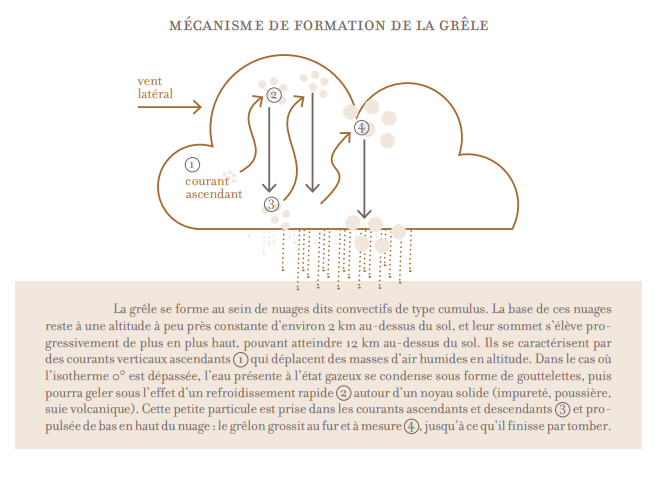
However, since antiquity, humans have tried to understand these climatic phenomena. As early as 1300 BC, the Chinese were the first to take a rigorous approach by making regular observations (snow levels, cloud appearance, wind strength). The Babylonians left behind clay tablets on which they recorded laws related to meteorology. The Greeks were likely the first to adopt an analytical and rational explanatory approach. At that time, meteorology encompassed a wide range of fields such as astronomy, geography, and even seismology. For Empedocles, a philosopher, poet, engineer, and Greek physician of the 5th century BC, the combination of the four elements—earth, water, air, fire—was thought to give rise to cold, heat, humidity, and dryness. Aristotle (384-322 BC) published a seminal work, “Meteorologica,” an exploration of celestial bodies and phenomena. He attempted to explain certain phenomena such as wind and the water cycle. He posited that the exhalation drawn from the earth by the sun’s heat governs atmospheric phenomena. He understood that cloud formation requires a drop in temperature. He rightly believed that dew, fog, hail, snow, and rain stemmed from the same phenomenon: condensation. However, he was mistaken in thinking that air temperature increases with altitude and explained this by a warmer layer of ether at the top of the atmosphere. Thus, he thought hail formed near the ground after water droplets passed through colder layers during their descent. The reality is the opposite (see box), but his vision was already broadly relevant for his time.
René Descartes (1596-1650) believed that thunder is produced when the highest clouds suddenly fall onto lower ones. A Dutch physicist, Hermann Boerhaave (1668-1738), proposed a theory for the formation of hail: water particles lifted by the sun form clouds and compose ice masses. The 18th century marks the beginning of modern science. Several experiments during this time demonstrated the electrical nature of storms and lightning, leading Benjamin Franklin to invent the first lightning rod.
Efforts were made to counteract these hailstorms. In the early 19th century, there was an international enthusiasm for electric hail rods: wooden poles 10-15 meters long, equipped with a brass tip grounded by a metal wire, and curiously even by a cord made of wheat or rye straw, through which ran a cord of unbleached linen. Very quickly, some scientists expressed skepticism about the alleged success of these experiments, doubting that a few armed poles at ground level could protect against hail formed at considerable heights and driven by strong winds. Hail rods were defended by enthusiastic amateurs, inventor agronomists, pastors, professors, winemakers, and farmers. These controversies led to interesting debates. In 1926, enthusiasm in Switzerland suddenly waned in the canton of Vaud following devastating hailstorms in areas believed to be protected. Consequently, public enthusiasm turned into bitterness: poles and metal wires were torn down and sold at auction!
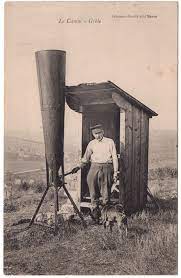
In 1880, an Italian professor declared that it was conceivable to prevent the formation of hailstones by injecting smoke particles using cannons. A device based on this idea was tested in Austria in 1896: when fired, the mortar produced a loud whistling ring of smoke that rose to a height of 300 meters. These cannons generated enthusiasm among the agricultural and viticultural communities. In the context of the phylloxera crisis and with political support, many countries equipped themselves with these devices, with nearly 10,000 cannons in Italy.
By 1901, new lines of thought emerged, casting doubt on their effectiveness. In 1903 and 1904, the Austrian and Italian governments began a study based on the installation of 222 cannons: the experiment was deemed a failure. “Opponents emphasized the disproportion of forces involved: on one side, the irresistible power of natural agents—wind, water, and lightning, which is an electrical spark several kilometers long—and on the other side, a sparse artillery barely capable of sending a crown of smoke a few meters without mass or force.” In France, around 1900, 40-meter-high pylons equipped to discharge atmospheric electricity were constructed. These pylons, called « niagaras, » multiplied in vineyard regions but were abandoned by 1920 due to lack of effectiveness. Other methods then emerged: rockets and cloud seeding. The latter method, developed by the United States and especially the former USSR, involves sending silver iodide into the cloud: by increasing the number of freezing nuclei, it is hoped to increase the number of hailstones at the expense of their size. Aside from the toxicity of silver iodide falling with the rain, experiments conducted in at least 15 countries from 1965 to 2005 yielded often mixed or null results. The effectiveness of the anti-hail cannon, believed to have a disintegrating effect on hailstones through shock waves within the cloud, is also controversial and has not been demonstrated. Finally, a last method involves diffusing hygroscopic salts (calcium chloride/aluminum salts and sodium chloride) into the thunderstorm cell using helium-filled balloons, intended to replace hailstones with rain. These techniques remain uncertain or scientifically unfounded in some cases, but the collective belief in being protected remains a reassuring factor against this random and devastating climatic hazard.
The most reliable method is the vertical anti-hail net, which is underutilized due to the high cost of installation and maintenance.
Brigitte Savigneux based on an article by Joël Rochard